¶ Wing Systems
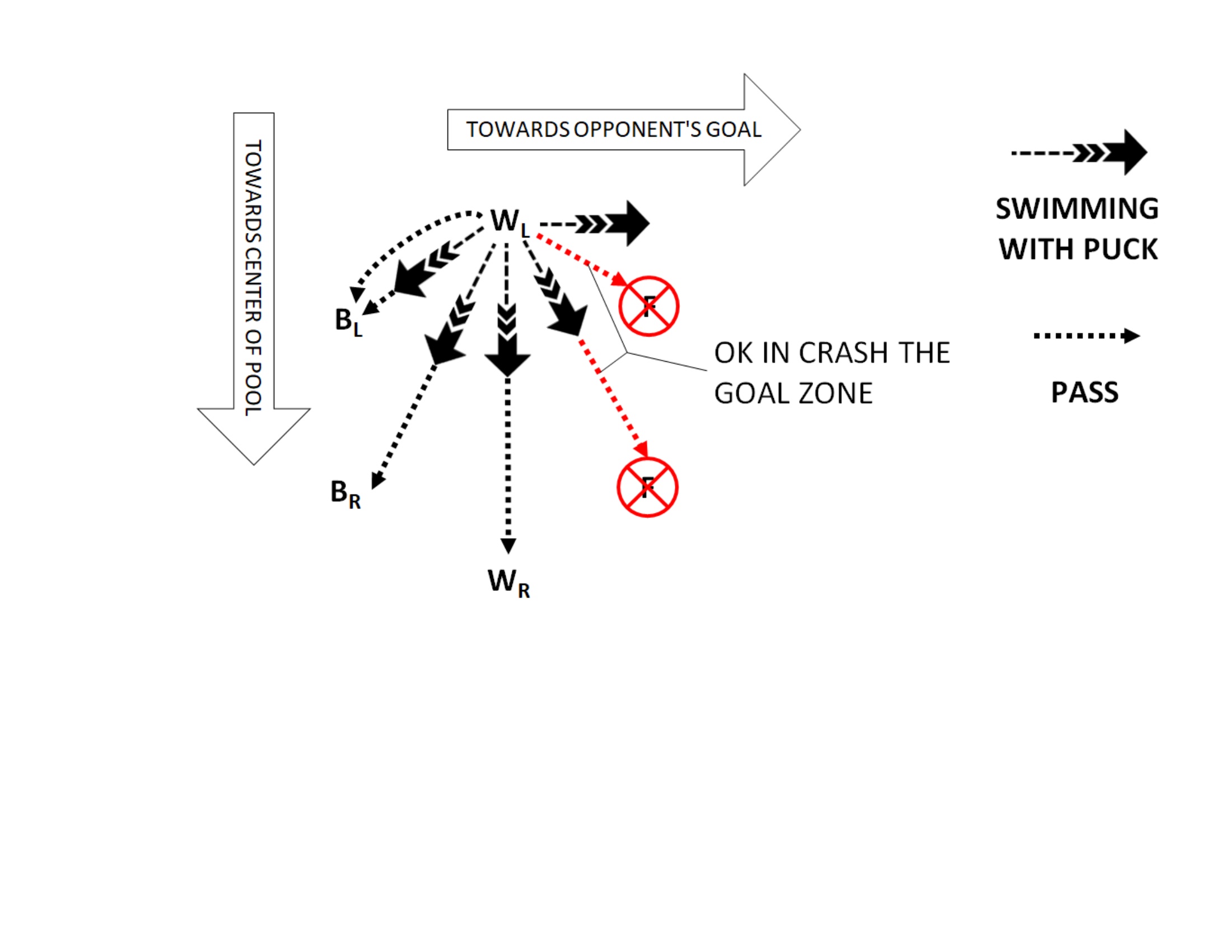
The Wings provide the outside pressure and structure for the formation.
Their primary responsibilities are:
- Prevent the opposing team from advancing around the outside of the formation
- Funnel the puck toward the center and support structure
- Support offensive progression through controlled movement and pressure
- Maintain defensive balance during transitions
The passing and swimming options available to the Wings are shown in the diagram above.
The position shown represents the Wing’s real-time location. If the Wing moves from position “A” to position “B”, the same movement and passing principles apply throughout the movement. This allows the Wing to:
- Read the play dynamically
- Move according to available space
- Maintain predictable support structure for teammates
¶ Strong Wing
¶ Primary Purpose
The Strong Wing is the formation’s primary offensive pressure player.
¶ Main Responsibilities
- Aggressively attack open-water lanes
- Drive offensive progression through space
- Maintain continuous movement while in possession
- Create offensive pressure through controlled movement
¶ Offensive Role
The Strong Wing should:
- Attack through or across the centerline
- Focus on movement rather than direct stick battles
- Advance the puck through:
- Controlled puck handling
- Continuous movement
- Quick support passing
¶ Important
While in possession:
- Keep moving
- Avoid becoming stationary
- Maintain awareness of support options
¶ Support and Recovery
If support becomes unavailable:
- Move toward the Weak Wing side
- Look for a Back as a recycle option
Avoid:
- Stopping while low on air
- Becoming trapped without support
The Strong Wing should plan:
- Dives
- Movement
- Recovery routes
around available support positioning.
¶ Weak Wing
¶ Primary Purpose
The Weak Wing acts as the formation’s Last Back.
¶ Main Responsibilities
- Maintain defensive balance
- Protect the center recovery lane
- Prevent breakaways through the middle
- Support offensive transitions safely
¶ Positioning Guidelines
The Weak Wing should maintain positioning between:
- The puck
- The center of the defended tray
¶ Supporting Strong Wing Transitions
When the Strong Wing cuts across the formation:
- The Weak Wing may move up to support
- Nearby Backs temporarily help cover Last Back responsibilities
¶ Important
The Weak Wing should:
- NOT move ahead of the Strong Wing
- Continue acting as a recovery layer
Passes to the Weak Wing should still be:
- Backward-directed support passes
- Even if mostly lateral
¶ Advancing After Receiving the Puck
After receiving possession:
- The Weak Wing may cut across the Strong Wing’s fins
- Continue advancing up-pool through open space
Avoid:
- Immediately attacking the wall the Strong Wing just vacated
Why:
- Support may not yet have recovered to that side
¶ Last Back Responsibilities (Weak Wing)
When defending an opponent breakaway, the Weak Wing acts as the formation’s Last Back.
Responsibilities should be prioritized in the following order:
¶ 1. Do NOT Lunge for the Puck
- Avoid overcommitting directly at the puck carrier
- Opponents often use lunges to maneuver around defenders
Priority:
- Stay controlled
- Maintain positioning
¶ 2. Protect the Direct Lane to Goal
Position the body and/or stick between:
- The puck carrier
- The defended tray
¶ Highest Priority
Prevent a direct scoring lane.
¶ 3. Force the Opponent Wide
Guide the attacker toward:
- Defensive corners
- Side walls
- Areas away from the center lane
¶ Best Outcome
- Stop the attack against the wall
¶ 4. Limit Support Passing Lanes
Once the puck carrier is controlled:
- Reduce passing opportunities
- Disrupt lateral support options
¶ Important
The puck carrier remains the primary threat.
Stopping the puck carrier takes priority over:
- Covering secondary attackers
Recovering teammates are more likely to cover support players through the middle.
¶ Things to Avoid as a Wing
¶ Avoid Letting the Play Get Around the Outside
- Maintain outside defensive coverage
- Prevent opponents from advancing between the formation and the wall
¶ Recovery Priority
If possession is lost after moving toward the center:
- Surface diagonally back toward your side
- Re-establish defensive positioning quickly
¶ Avoid Taking the Puck Toward Your Own Strong-Side Wall
If carrying or receiving the puck in the Muffin Zone:
- Avoid drifting back toward the strong-side wall
- Unless there is a clear attacking opportunity
¶ Why
Moving outward:
- Exposes the outside lane
- Reduces support options
- Creates vulnerability when low on air
¶ Preferred Response
- End the dive
- Leave the puck in the Muffin Zone
- Allow support players to continue the attack
¶ Avoid Being Forced to the Wall
If pressure pushes the Wing outward:
- Turn inward early
- Curl
- Pass back to a Back
¶ Important
Do this BEFORE reaching:
- Approximately 2m from the side wall
¶ Avoid Passing Directly to a Forward Outside the Crash the Goal Zone
Forwards are generally not positioned to safely support Wings during open-water play.
¶ Preferred Option
- Pass diagonally backward to a Back
- Allow the Back to determine whether a Forward pass is appropriate
¶ Avoid Losing the Puck Forward
- Prioritize controlled progression
- Avoid forcing risky forward plays
- Recycle possession when necessary
¶ Avoid Getting Too Close as a Weak Wing
The Weak Wing must maintain enough spacing to:
- Perform effective Kelp Dives
- Present a defensive obstacle
- Avoid interfering with the Backs
¶ If Too Close
- Defensive coverage weakens
- Recovery becomes difficult
- Central support lanes become congested
¶ Avoid Moving Too Far Ahead as a Weak Wing
The Weak Wing must remain positioned:
- Between the puck and the center of the defended tray
¶ If Too Far Forward
- Wall coverage weakens
- Recovery angles worsen
- Opponent breakaways become more dangerous
¶ Quick Reference
| Role | Focus |
|---|---|
| Strong Wing | Offensive pressure and movement |
| Weak Wing | Last Back and defensive balance |
| Possession | Maintain movement and support |
| Recovery | Protect center recovery lanes |
| Passing | Recycle safely through support |